


AI SEO services optimize your brand for the AI-driven search era — so ChatGPT, Gemini, Perplexity, and Google's AI Overviews cite, quote, and recommend you, not just rank you. Here's what they include, what they cost, and whether they're worth it.
Table of Contents
- What are AI SEO services? (The short answer)
- What does AI SEO do?
- Using AI in SEO vs. AI SEO services: the difference
- What are SEO services and types — the 4 types of SEO
- What is AI SEO called? GEO, AEO, AIO & LLMO
- What AI SEO services include and what's available
- Can ChatGPT do SEO? Where AI tools help — and don't
- What is the best SEO AI? Free and paid AI services
- How much should I pay for SEO services?
- Will AI replace SEO? Does Google offer SEO services?
- Are AI SEO services worth it?
- How Gobiya delivers AI SEO services
- Frequently Asked Questions
What are AI SEO services? (The short answer)
AI SEO services are optimization services that make your brand visible in AI-powered search — getting your content cited, quoted, and recommended inside answers from ChatGPT, Google's AI Overviews, Gemini, Perplexity, and Claude, not just ranked in traditional blue links. Where traditional SEO targets keyword rankings and backlinks, AI SEO services add layers built for how AI models select and cite sources: Generative Engine Optimization (GEO), Answer Engine Optimization (AEO), entity and structured-data optimization, AI citation tracking, and multi-platform visibility monitoring.
As Google itself states, optimizing for generative AI search is still fundamentally SEO. AI SEO services apply that foundation to the AI answer layer, where discovery is increasingly happening.
What does AI SEO do?
AI SEO does one core thing: it makes your brand the answer AI engines give, rather than a link a user has to dig for. Traditional search returns a list of ranked links; AI search synthesizes a single answer from multiple sources and cites a few of them. AI SEO is the work of becoming one of those cited, recommended sources.
Concretely, AI SEO does the following:
- →Earns citations in AI answers — structuring content so large language models extract and attribute it when answering user questions in ChatGPT, Perplexity, Gemini, and Google AI Overviews.
- →Builds brand entity clarity — making your brand consistently understood across the web (your site, Wikipedia, Reddit, reviews, press) so AI models associate you with your topics with confidence. This is closely related to how brand entity extraction works.
- →Improves extractability — clear structure, direct answers, FAQs, and evidence (statistics, named sources, expert quotes) that AI systems can lift cleanly. The first peer-reviewed GEO study found these elements raised AI citation rates by 30–40%.
- →Tracks AI visibility — monitoring how and where your brand appears (or doesn't) across AI platforms, the AI-era equivalent of rank tracking.
- →Protects traditional rankings too — because AI answers still pull heavily from top-ranking, authoritative content, so AI SEO reinforces classic SEO rather than abandoning it.
The shift driving all of this: AI Overviews and chat-based search are reducing clicks to traditional results, so visibility increasingly means being inside the answer — which is exactly what AI SEO does.
Using AI in SEO vs. AI SEO services: what's the difference
These two phrases sound identical but mean different things, and the distinction matters when you're buying.
| Approach | What it means |
|---|---|
| Using AI in SEO | Using AI tools to do SEO work faster — generating content drafts, clustering keywords, automating audits. AI as a productivity assistant for traditional SEO tasks. |
| AI SEO services | Optimizing for AI search engines as the destination — making your brand visible inside AI-generated answers. The "AI" describes the target (AI search), not just the tooling. |
A quality provider does both: uses AI to execute efficiently and optimizes for AI search engines as the goal. The warning sign is an agency that's simply rebranded traditional SEO as "AI SEO" with buzzwords while changing nothing about the methodology — ask whether they actually optimize for AI citation visibility, or just use AI to write the same old content.
What are SEO services and types — including the 4 types of SEO
To place AI SEO in context, it helps to know what SEO services are and the four types of SEO. SEO services are the work of improving a site's visibility in search, traditionally measured by where it ranks for relevant queries. The classic 4 types of SEO are:
| Type of SEO | What it covers |
|---|---|
| On-page SEO | Content, keywords, titles, headings, internal structure on your own pages |
| Off-page SEO | Backlinks, brand mentions, and authority signals from other sites |
| Technical SEO | Crawlability, site speed, indexing, structured data, mobile-friendliness |
| Local SEO | Google Business Profile, local citations, map-pack visibility for location-based searches |
AI SEO doesn't replace these four — it adds a fifth dimension that runs across all of them: optimizing for how AI engines interpret, trust, and cite your content. On-page becomes "extractable answer blocks," off-page becomes "entity consistency and co-citations across trusted sources," technical adds "AI-crawler access and schema for LLM comprehension," and local feeds the AI answers that recommend businesses. In other words, AI SEO is the four types of SEO, re-pointed at the AI answer layer.
What Is AI SEO Called? GEO, AEO, AIO & LLMO Explained
If you're wondering what AI SEO is called, you'll encounter several overlapping names — and as of early 2026 there's no single agreed definition separating them; they're often used interchangeably. The main terms:
- →AI SEO — the umbrella consumer term for optimizing for AI search.
- →GEO (Generative Engine Optimization) — optimizing to be cited by generative engines like ChatGPT, Gemini, and Claude; emphasizes brand entity consistency and authority across many sources. Our guide on how Knowledge Graph optimization relates to GEO explains the distinction in full.
- →AEO (Answer Engine Optimization) — optimizing on-page content (direct answer blocks, FAQ schema) so AI extracts factual answers and attributes them to you; targets features like Google's AI Overviews.
- →AIO / LLMO — broader and alternate labels for the same goal of AI visibility.
Google's own position is that "optimizing for generative AI search is optimizing for the search experience, and thus still SEO." The labels differ, but the underlying work — clear, authoritative, well-structured, trustworthy content — is continuous with good SEO.
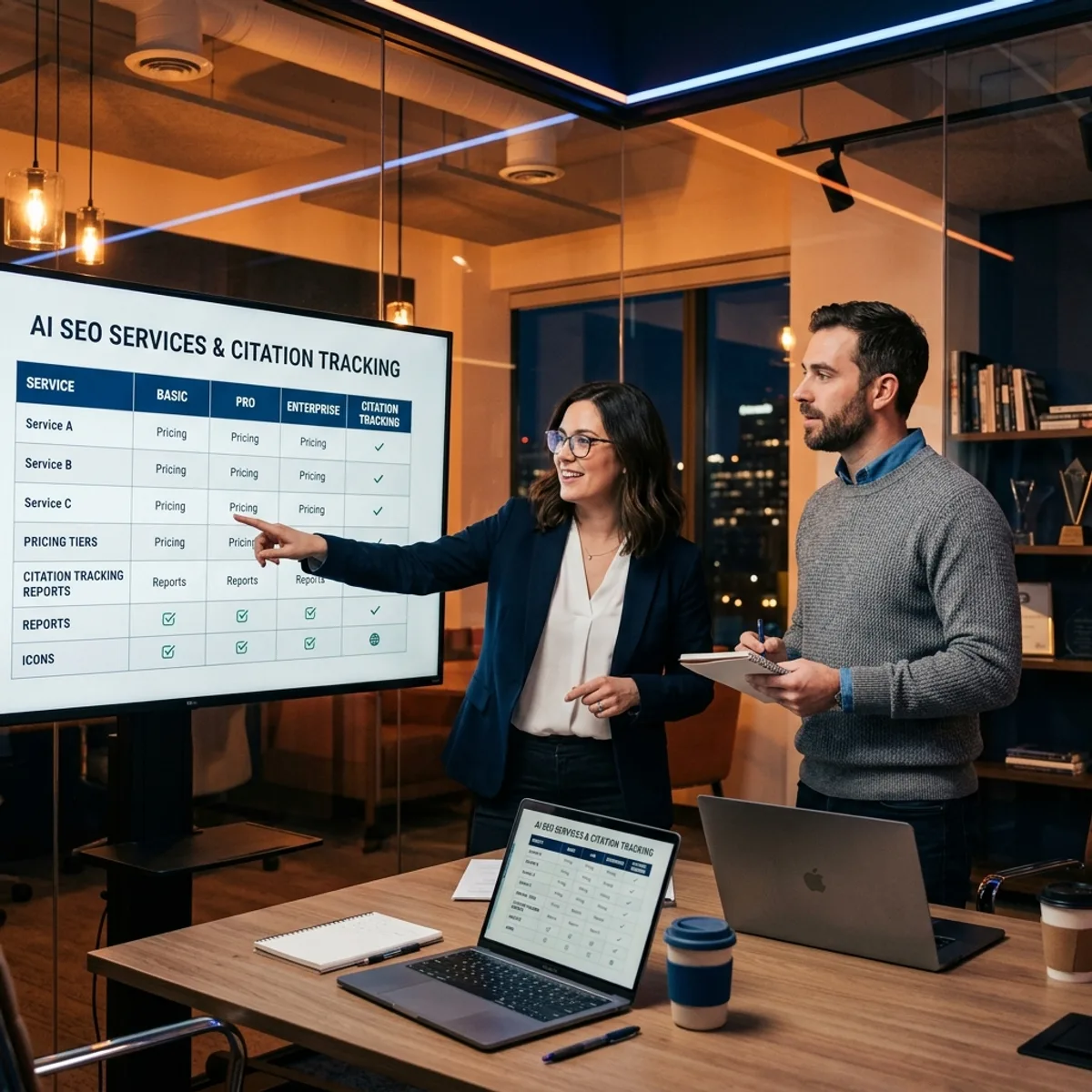
AI SEO services are priced as ongoing retainers — not one-time sprints — because AI search evolves continuously.
What AI SEO Services Include and What's Available
So what AI services are there for SEO, and what does a real provider actually deliver? A full AI SEO engagement typically includes some or all of the following:
- →AI visibility audit — baseline of how often (and how) your brand currently appears across ChatGPT, Gemini, Perplexity, and AI Overviews.
- →Generative Engine Optimization (GEO) — building brand entity consistency and authoritative presence across the sources AI engines trust. Understanding which data sources LLMs crawl to verify your brand is foundational to this work.
- →Answer Engine Optimization (AEO) — restructuring content into extractable answer blocks, FAQs, and schema so AI can cite it.
- →Entity & structured-data optimization — clarifying who you are and what you're an authority on, so AI models map your brand to the right topics.
- →Technical readiness for AI crawlers — ensuring AI bots can access, parse, and interpret your content.
- →AI citation tracking & monitoring — ongoing measurement of mentions, share of voice, and sentiment across AI platforms.
- →Content strategy — evidence-rich, decision-useful content (data, expert quotes, comparisons) that performs in both AI and traditional search.
What separates genuine AI SEO from traditional SEO with new labels
A credible provider can show you a citation report from a current client and a roadmap with measurable milestones — not just promises. Ask for both before signing.
Can ChatGPT do SEO? Where AI tools help — and where they don't
Can ChatGPT do SEO? Partially. ChatGPT and similar AI tools are genuinely useful for SEO tasks — drafting content, brainstorming keywords and topics, generating FAQ schema, outlining articles, summarizing competitor pages, and speeding up research. Used well, they save substantial time. But ChatGPT cannot, on its own, do your SEO:
- ✗It can't audit your live site's technical health, crawl your pages, or implement fixes.
- ✗It can't build genuine authority, earn real citations, or establish the cross-web entity consistency GEO requires.
- ✗It produces generic output that needs human expertise to fact-check, add original insight, and align to your brand — Google rewards quality and trustworthiness regardless of who or what wrote it, but mass unedited AI content is a real risk to both SEO and brand.
The consensus in 2026: the strongest results are AI-assisted but human-led. ChatGPT is a powerful assistant for SEO execution; it is not a replacement for an SEO strategy, a technical implementation, or the authority-building that AI SEO services provide.
What is the best SEO AI? Free and paid AI services
What is the best SEO AI? There's no single "best" — it depends on the job, and the strongest setups combine several tools with human strategy. Categories of AI services for SEO, including what AI services are free to start:
- →AI writing/assistant tools (ChatGPT, Claude, Gemini) — drafting and ideation; free tiers available.
- →AI-integrated SEO platforms (Semrush, Ahrefs and similar, with AI-visibility features) — keyword, content, and increasingly AI-citation tracking; mostly paid, some free trials.
- →AI visibility / citation trackers — monitor how your brand appears across AI platforms; emerging category, mix of free and paid.
- →Google's own free tools — Search Console and Google's published AI-optimization guidance are free and authoritative starting points.
The AI assistants' free tiers, Google Search Console, and Google's documentation cost nothing and are a legitimate starting point. But tools are only levers — the best SEO AI outcome comes from pairing them with expertise, because no tool by itself builds the authority and entity signals that get you cited. The "best AI" is the one integrated into a sound, human-led strategy.
How Much Should I Pay for SEO Services? Average Cost for SEO Services
AI SEO is priced as a service (a retainer or project), not a software subscription. The 2026 market:
| Tier | Typical monthly cost | What it covers |
|---|---|---|
| Entry-level | ~$1,500–$3,000/mo | Basic content optimization, foundational AEO, limited tracking |
| Mid-market | ~$3,000–$6,000/mo | Technical + content + entity building; the common range for most businesses |
| Specialist/full-stack | ~$6,000–$15,000/mo | Full GEO + AEO + LLM citation strategy, prompt audits, multi-platform |
| Enterprise | ~$15,000–$25,000+/mo | Multi-market, many pages, deep reporting across business units |
Project-based work (an audit, schema overhaul, or content-cluster build) commonly runs $5,000–$50,000 depending on scope. Budget for 9–12 months to reach the compounding-returns phase — AI search evolves continuously, and a one-time sprint loses impact within 60–90 days. Evaluate on cost per outcome (AI appearances, content produced, queries tracked) rather than the retainer alone, and be wary of the cheapest option, which often rebrands thin traditional SEO as "AI SEO."
Will AI Replace SEO? Does Google Offer SEO Services?
Will AI replace SEO? No. AI is being absorbed into SEO, not replacing it. AI engines rely entirely on human-made web content, authority signals, and SEO foundations — without indexed, trustworthy, well-structured content, AI has nothing reliable to summarize. What's changing is the surface (answers instead of links) and the metrics (citations and brand mentions alongside rankings and clicks), not the underlying need to be discoverable, authoritative, and trustworthy. SEO is evolving into AI search optimization, not disappearing. For the mechanics of why, our guide on how GEO and AI retrieval actually work is the right place to start.
Does Google offer SEO services? No — Google does not sell SEO services, and it warns against anyone promising guaranteed rankings. What Google does offer is free guidance: Search Console, Search Central documentation, and, in 2026, official documentation on optimizing for generative AI features. Google's stance is that good AI-search optimization is good SEO; it provides the rules, not the service. The service — the actual implementation and authority-building — is what an AI SEO provider does.
Are SEO Services Worth It? Are AI SEO Services Worth It?
Are AI SEO services worth it? For most businesses whose customers are increasingly using AI to research and decide, yes — with two honest caveats. They're worth it when: your buyers use ChatGPT, Perplexity, or Google AI Overviews to find solutions like yours; you have (or will build) genuine quality and authority for AI to cite; and you commit to the 9–12 month horizon where compounding returns appear. Gartner has reported companies using generative-optimization services seeing meaningfully higher brand visibility in AI answers than those relying on traditional SEO alone — and with AI Overviews reducing clicks to classic results, being in the answer is increasingly where visibility lives.
They're not worth it if you expect 30-day miracles (a red flag), if you buy the cheapest "AI SEO" that's just relabeled traditional work, or if your underlying site and content are too weak for any optimization to surface — in which case fix the foundation first. The honest framing: AI SEO is a real, increasingly necessary investment for businesses competing for AI-era visibility, but only when matched to genuine quality and a realistic timeline, not a quick-fix purchase.
How Gobiya Delivers AI SEO Services
Gobiya treats AI search visibility as an engineering problem with measurable inputs, not a buzzword. Our SEO and AI-discoverability practice covers the full AI SEO stack: an AI visibility audit to baseline where your brand appears across ChatGPT, Gemini, Perplexity, and AI Overviews; GEO and AEO work to make your content extractable and your brand entity consistent across the sources AI engines trust; structured data and technical readiness for AI crawlers; and ongoing citation tracking so visibility gains are measured, not assumed.
Because we build on fast, clean, crawlable infrastructure, the technical foundations AI systems reward are built in rather than bolted on — and because everything is wired into native CRM and pipeline attribution, we connect AI visibility to actual inquiries and revenue, not vanity mentions. If you want to know where you stand, book a strategy call and request an AI visibility audit.
The right call on AI SEO services
AI SEO services are the work of making your brand visible — cited, quoted, recommended — inside AI-generated answers across ChatGPT, Gemini, Perplexity, and Google's AI Overviews, layered on top of the traditional SEO foundations that AI engines still depend on. They go by several names (GEO, AEO, AIO, LLMO), they're priced as ongoing services ($1,500–$25,000+/month by scope), and they're increasingly essential as search shifts from ranked links to synthesized answers.
Two decisions matter most. First: whether a provider genuinely optimizes for AI search — GEO, AEO, citation tracking, entity work — or just rebrands traditional SEO with AI buzzwords; ask for a citation report and a measurable roadmap. Second: whether you commit to the realistic 9–12 month horizon and pair the service with genuine quality, because AI SEO surfaces real authority, it can't manufacture it.
Book a free AI visibility auditFrequently Asked Questions
What does AI SEO do?
What are the 4 types of SEO?
Can ChatGPT do SEO?
What is the best SEO AI?
What is AI SEO called?
Will AI replace SEO?
Does Google offer SEO services?
How much should I pay for SEO services?
Are AI SEO services worth it?
Sources & further reading
- → Google Search Central — Optimizing for generative AI features on Google Search — Google's official position that optimizing for AI search is still SEO.
- → Generative Engine Optimization (Princeton, Georgia Tech, IIT Delhi) — the peer-reviewed study finding statistics, sources, and quotes raise AI citation rates 30–40%.
- → Google Search Central — SEO Starter Guide — the foundational SEO practices AI search still depends on.
Google Core Update & Penalty Recovery Checklist
A step-by-step technical guide to isolating algorithmic drops, diagnosing entity devaluation, and preparing reconsideration submissions.
- Isolate query drops from broad Core Update filters
- Link-profile triage checklist for manual actions
- Reconsideration letter copy-paste template